Connectors — What Works in Pakistan
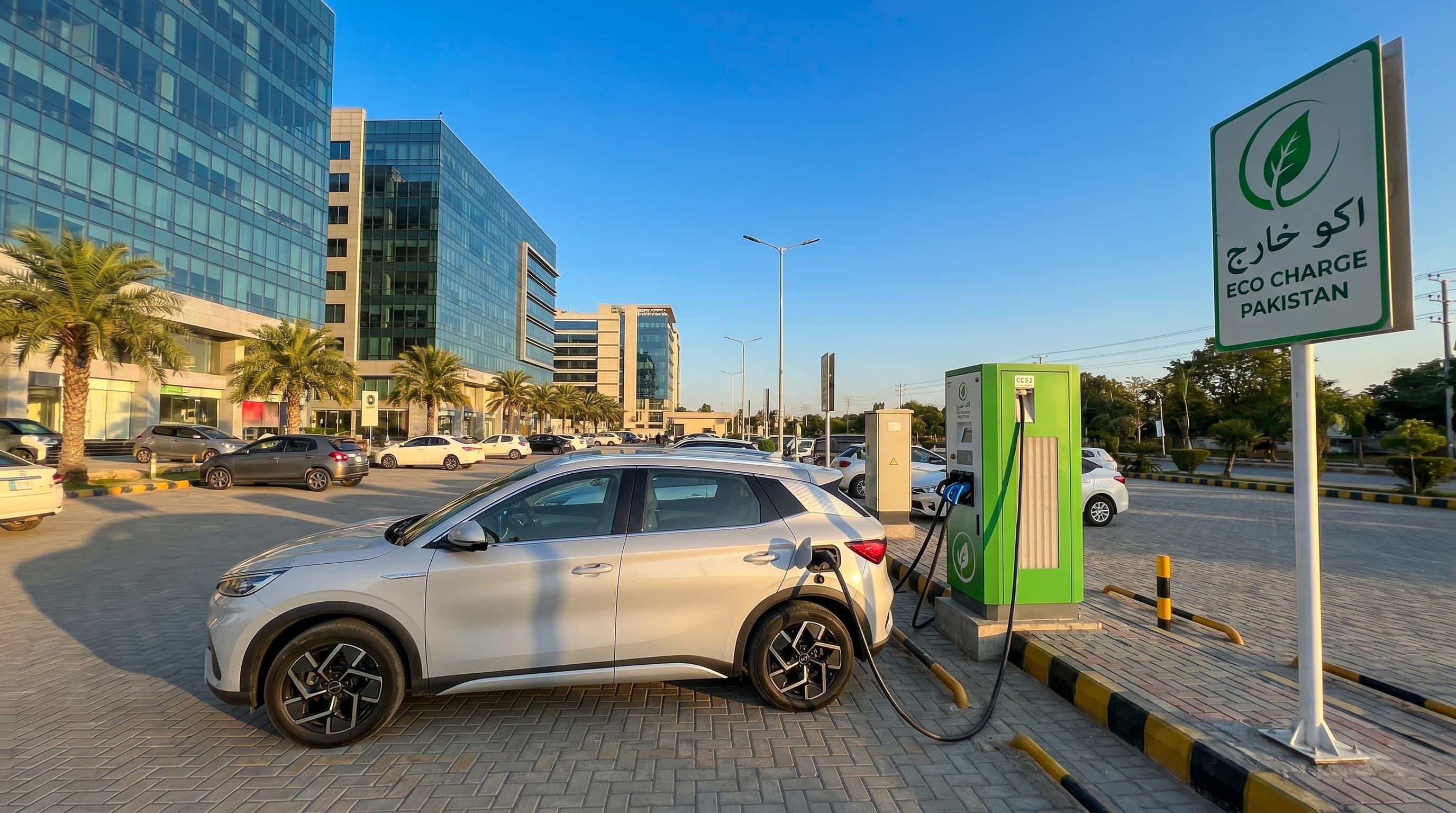
Pakistan has standardised on CCS2 (Combined Charging System 2) for DC fast charging. This is good news for Atto 3 owners: the car is fully CCS2 compatible out of the box. You will find CCS2 at Shell Recharge, PSO EV stations, HUBCO-backed chargers, and the growing network of third-party fast charging locations in major cities.
For AC charging, the Atto 3 uses a Type 2 inlet — also the dominant standard in Pakistan for AC wallboxes and public slow chargers. If you install a home wallbox (recommended), it will use a Type 2 cable.
One thing to be clear about: the Atto 3 does not have CHAdeMO compatibility, and it does not use the GB/T standard found on some Chinese imports not adapted for the Pakistani market. Stick to CCS2 for DC and Type 2 for AC and you will have no compatibility issues at any properly installed Pakistani charging station.
For occasional emergency charging, a standard 3-pin 16A socket (the kind in every Pakistani home) can be used with the included portable cable. The Atto 3 will draw around 3.3 kW from this, giving you roughly 18 to 20 hours for a full charge. Use this for top-ups in emergencies, not as a regular charging habit — long-term daily use of a domestic socket for EV charging is not recommended by BYD.
DC Fast Charging — Public Stations
This is where the Atto 3 genuinely impresses in the Pakistan context. The car's 80 kW DC fast-charging capability aligns almost perfectly with the most common charger output available at Pakistani public stations.
At a PSO or HUBCO 60 kW DC charger — the most widely deployed type across Pakistan — the Atto 3 will charge from 20% to 80% in approximately 40 minutes. That is a practical road-trip stop: enough time for a meal or coffee while the car charges. A 10% to 80% charge at these stations adds roughly 240 km of range.
At a Shell Recharge station — which operates chargers up to 180 kW — the Atto 3 will still cap at its 80 kW maximum. You are not wasting the station's capability; the car simply takes what it can handle. At 80 kW, the 20% to 80% window drops to around 30 to 35 minutes. Shell Recharge is the fastest public charging experience currently available for the Atto 3 in Pakistan.
The Atto 3 uses a standard charging curve: it charges at or near peak rate up to around 60 to 65%, then tapers as the battery approaches 80%. BYD recommends keeping regular charging between 20% and 80% for daily use — the "sweet spot" — which also keeps you in the fast part of the charging curve. For long trips, charging to 90% or 100% is perfectly fine occasionally; just expect the final 20% to take as long as the previous 60%.
AC Charging — Home Wallbox and Public Slow Chargers
The Atto 3's onboard AC charger is limited to 7 kW. This is an important number to remember. If you plug into a 22 kW public AC charger — the type found at some shopping malls and hotels — the car will still only draw 7 kW. The higher-rated charger makes no difference here; the limitation is the car's onboard charger, not the station.
At 7 kW — whether from a home wallbox or a public 7 kW station — a full charge from empty takes approximately 9 hours. Overnight charging is the obvious use case: plug in when you arrive home, wake up with a full battery. Adding 100 km of range takes roughly 2.5 hours at this rate.
At a 3.7 kW AC connection (a 16A single-phase socket or a 3.7 kW wallbox), charging time approximately doubles to around 17 to 18 hours. Usable for overnight top-ups if your daily mileage is modest, but a 7 kW wallbox is a far better investment.
Home Charging Setup — What You Actually Need
Setting up home charging properly is the single most important decision an Atto 3 owner will make. Done right, you will almost never need to visit a public station for daily driving.
The recommended setup is a Type 2 wallbox rated at 7 kW (32A single-phase). In Pakistan, installed wallboxes from brands like Hypervolt, EVBox equivalents, and locally sourced units typically cost between Rs 60,000 and Rs 120,000 including installation by a qualified electrician. The variance in price comes from cable length, brand, and whether your home's wiring needs upgrading to support a dedicated 32A circuit — which is advisable regardless.
The electricity cost depends on your tariff. Standard WAPDA/LESCO domestic slab rates range from Rs 30 to Rs 50 per unit depending on your consumption tier — households with air conditioning running in summer often land in higher slabs. The smarter option for EV owners is the NEV (New Energy Vehicle) electricity tariff offered by distribution companies: a flat rate of approximately Rs 39.70 per unit, applied to a separate meter dedicated to EV charging. This tariff is available by application at your local DISCO (distribution company) office and typically takes two to four weeks to activate.
At the NEV tariff rate of Rs 39.70/unit, a full charge of the 60.48 kWh battery costs approximately Rs 2,400. That gives you 340 to 380 km of real-world range. On the standard domestic tariff — assuming you average around Rs 45/unit in higher slabs — a full charge costs around Rs 2,720. Either way, home charging is by far the cheapest way to run the Atto 3.
Public Charging Costs — Shell Recharge vs PSO/HUBCO
When you do use public charging, the cost picture changes. Pakistan's public charging network currently operates at rates that reflect infrastructure investment costs:
- Shell Recharge: Rs 105 per kWh. A 20% to 80% DC fast charge adds roughly 36 kWh, costing approximately Rs 3,780. A full public charge from near-empty costs around Rs 6,350.
- PSO / HUBCO stations: Rs 90 to 100 per kWh. A 20% to 80% charge costs approximately Rs 3,240 to Rs 3,600. A full charge runs Rs 5,440 to Rs 6,050.
These public charging costs are notably higher than home charging — roughly 2.5 times more expensive per kWh. This is normal and expected; public infrastructure has capital and operating costs baked into the tariff. The practical implication: use home charging for your daily driving, and budget for public charging as an occasional top-up or road-trip expense.
Real Running Costs vs Petrol — The Numbers That Matter
Here is where the Atto 3's value proposition becomes very clear. Let us run the numbers against a typical petrol sedan — a Toyota Corolla doing 10 litres per 100 km, which is realistic in mixed Pakistani city and highway driving.
At Rs 280 per litre of petrol (mid-2026 pricing), that Corolla costs Rs 28,000 per 1,000 km in fuel alone. Maintenance — oil changes every 5,000 km, filters, belts — adds another Rs 3,000 to 5,000 per 1,000 km on average.
The Atto 3 charged entirely at home on the NEV tariff costs approximately Rs 3,000 to Rs 3,200 per 1,000 km in electricity. Even if you use a 50/50 mix of home and public charging, you are looking at Rs 4,500 to Rs 5,500 per 1,000 km. BYD's LFP battery chemistry and simplified drivetrain also mean significantly lower maintenance costs: no oil changes, no timing belts, no transmission fluid. Brake wear is reduced by regenerative braking.
The savings over a petrol equivalent run to Rs 22,000 to Rs 25,000 per 1,000 km in fuel alone. For a driver covering 2,000 km per month — a realistic figure for a commuter in Lahore or Karachi — that is a monthly saving of Rs 44,000 to Rs 50,000. Over a year, the Atto 3's higher purchase price becomes significantly less intimidating when viewed against the operating cost advantage.
Pakistan's solar advantage amplifies this further. If you have rooftop solar — and net metering penetration among upper-middle-class households has grown sharply — your effective electricity cost for EV charging during daylight hours drops dramatically. Some Atto 3 owners with adequate solar capacity report effective per-kilometre fuel costs below Rs 1.50. The petrol equivalent at current prices is over Rs 28 per kilometre.
Motorway Driving — Can You Do Lahore to Islamabad?
This is the question every potential Atto 3 buyer asks. The Lahore to Islamabad motorway (M-2) is approximately 375 km. The Atto 3's real-world range in Pakistan is 340 to 380 km. The arithmetic looks tight.
In practice, the Lahore-to-Islamabad run is doable on a single charge — but only with the right preparation. Start with your battery at 90% or above. Drive at a steady 100 to 110 km/h rather than 120 to 130 km/h — highway speed has a significant impact on range, and slowing down by 15 km/h can extend range by 30 to 40 km. Use Eco mode. Keep air conditioning at a moderate setting.
The smarter approach — and what most experienced EV road-trippers recommend — is to plan a stop at Bhera Interchange, roughly the midpoint of the motorway. There are CCS2 DC fast chargers at Bhera service area. A 20-minute stop at 60 to 80 kW adds 60 to 80 km of comfort margin and eliminates any range anxiety entirely. You arrive in Islamabad relaxed rather than watching the battery indicator.
For shorter inter-city routes, the Atto 3 handles them easily without any planning. Karachi to Hyderabad (165 km) requires no charging stop. Lahore to Faisalabad (130 km) is similarly straightforward. Islamabad to Peshawar (170 km) is fine on a full charge. The Atto 3 is well-suited to Pakistan's medium-distance inter-city travel patterns.
Charging Tips for Pakistani Atto 3 Owners
- Apply for the NEV electricity tariff immediately. The saving versus standard domestic slabs is material over a year of charging. Visit your DISCO office with your CNIC, property documents, and vehicle registration. Processing takes two to four weeks.
- Install a dedicated 32A circuit for your wallbox. Do not share the wallbox circuit with other high-draw appliances. Have a licensed electrician assess your consumer unit before installation.
- Charge to 80% for daily use, 100% before long trips. LFP chemistry handles 100% charges better than NMC, but staying in the 20 to 80% range keeps you in the fastest portion of the charging curve for top-ups.
- Pre-condition the battery before a long motorway run. If the temperature has been extreme overnight, letting the car warm up or cool down to operating temperature before departure — using the app's pre-conditioning feature — optimises charging speed and range.
- Download the Shell Recharge and PSO charging apps before your first long trip. Both require registration and payment setup. Do not leave this for a service station forecourt when your battery is at 10%.
- Keep a Type 2 portable cable in the boot. BYD includes one. It is your fallback for hotel charging, home sockets, or any Type 2 AC outlet you encounter at a shopping mall.
- Use regenerative braking in the city. The Atto 3 offers adjustable regeneration levels. On one-pedal driving settings in urban traffic, regen can meaningfully extend city range — particularly useful in Karachi's stop-and-go conditions.
The Bottom Line
The BYD Atto 3 is one of the most sensible EV purchases available in Pakistan in 2026. Its 60.48 kWh LFP Blade Battery is durable, well-suited to Pakistan's heat, and backed by an 8-year warranty. CCS2 compatibility means it works seamlessly with Pakistan's dominant public charging standard. The 80 kW DC fast-charging capability is well matched to what PSO and Shell Recharge stations actually deliver.
The real advantage, though, is in the running costs. Charged at home on the NEV tariff, the Atto 3 costs around Rs 3,000 per 1,000 km — compared to Rs 28,000-plus for a petrol sedan of comparable size. For a buyer covering meaningful monthly mileage, the Atto 3's purchase price premium over a petrol alternative starts paying back quickly. Understanding how to charge it properly — the connectors, the costs, the infrastructure — is the final piece that makes the ownership experience genuinely excellent rather than just theoretically appealing.