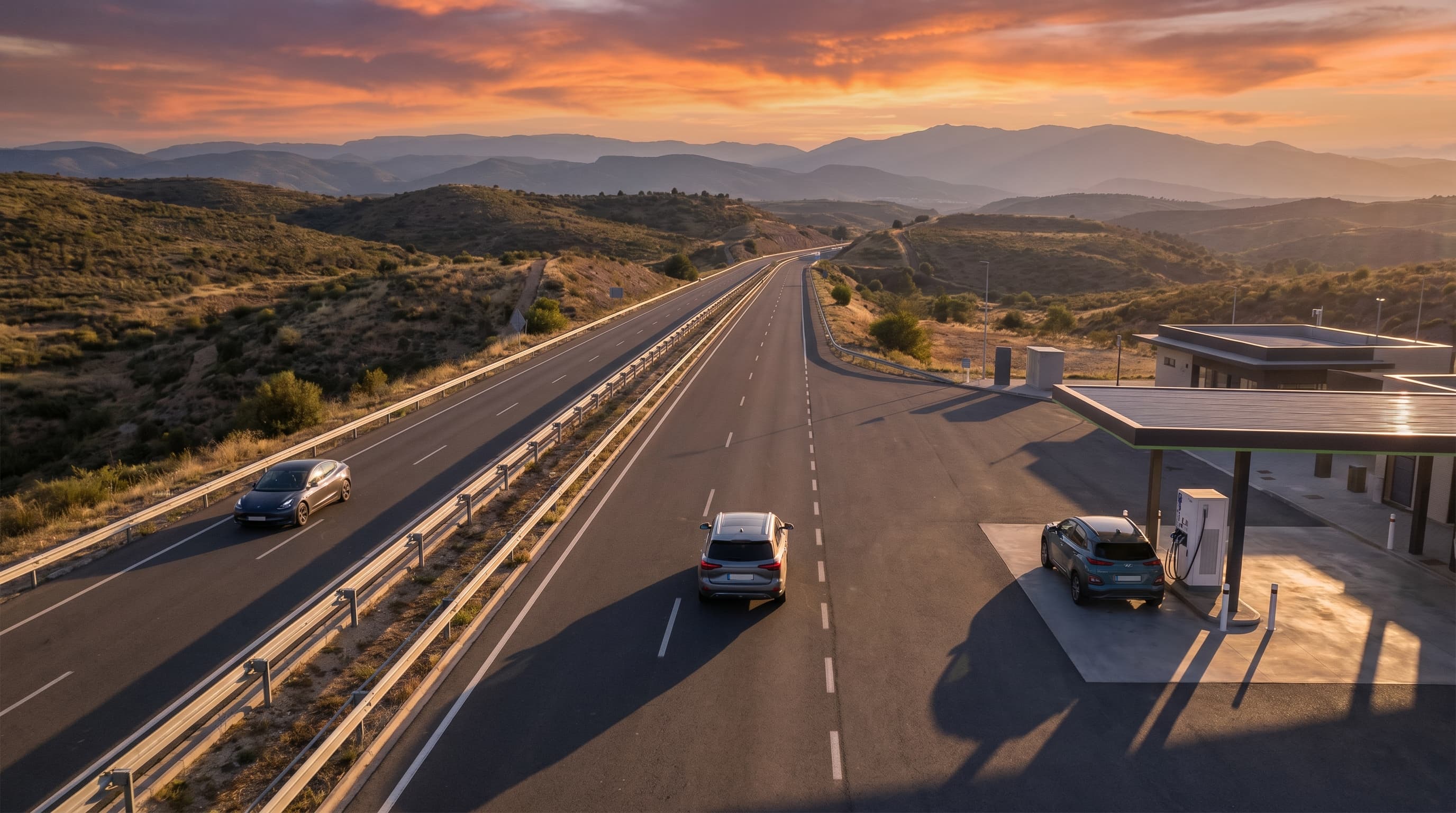
Pakistan's motorway network is one of the country's proudest infrastructure achievements — smooth, well-lit, and stretching from the Khyber Pass foothills all the way to Sindh's plains. But for EV drivers, those ribbons of asphalt present a very different challenge than they do for petrol-car owners. Charging infrastructure across the network is patchy, uneven, and in some corridors dangerously sparse.
This guide covers every major motorway in Pakistan — M-1 through M-9 — with honest assessments of charging availability, route difficulty, recommended vehicles, and practical strategies for completing each journey safely. Whether you're driving a BYD Seal from Lahore to Islamabad or attempting the M-5 in an MG ZS EV, this is the resource you need before you leave.
Data is current as of May 2026. Charging infrastructure in Pakistan is expanding rapidly — always verify station status directly before any long-distance journey.
Understanding Pakistan's EV Charging Network
Before examining each motorway individually, it helps to understand who operates Pakistan's public charging infrastructure and what standards they use.
HUBCO Green is the largest DC fast-charging network in Pakistan, with a strong presence on the M-2 corridor. Their stations typically deliver 60 kW via DC CCS2 connectors — adequate for BYD, MG ZS EV, and most modern Chinese EVs sold in Pakistan. A full charge from 20% to 80% on a BYD Seal takes approximately 40–50 minutes at a 60 kW station.
PSO (Pakistan State Oil) has integrated EV chargers at selected service areas, initially as a pilot programme and now as a rolling expansion. PSO stations on the motorway network typically offer both DC fast charging and AC Level 2 options. Their locations at established service areas — with food, washrooms, and rest facilities — make them particularly valuable for long-distance travellers.
Shell Recharge operates primarily in Karachi and the M-9 corridor, offering a well-maintained network with a reliable app-based payment system.
Private operators — including hotel chains, petrol stations, and commercial plazas — fill gaps at various points along the network, though their reliability and uptime varies considerably.
The primary connector standard for DC fast charging in Pakistan is CCS2, which covers BYD Seal, BYD Atto 3, and most recent MG models. CHAdeMO, used by older Nissan Leaf imports, is rare. AC charging uses Type 2 (Mennekes). Always confirm your vehicle's connector type before planning a stop.
M-2: Lahore–Islamabad (375 km) — EV Readiness: Easy to Moderate
The M-2 is Pakistan's EV motorway. Of the entire national network, it is the only corridor where a long-range electric vehicle can complete the journey with genuine confidence — and where the supporting charging infrastructure has reached a level of maturity that makes trip planning straightforward.
The route connects Lahore with Islamabad over 375 kilometres, passing through Sohawa, Jhelum, Bhera, and Kallar Kahar. It carries Pakistan's heaviest inter-city traffic and was the first motorway to receive dedicated EV charging infrastructure.
Known charging stops on M-2:
- Ravi Toll Plaza area (Lahore end) — HUBCO Green and PSO both operate DC fast chargers here. This is the logical departure charge point for Lahore-origin journeys. If leaving Lahore from home, top up to 100% here before entering the motorway.
- Bhera Service Area (~200 km mark) — The most strategically located stop on the M-2. PSO and HUBCO both have DC fast chargers. This is the natural mid-journey charge stop for standard-range EVs. Expect 30–45 minutes for a 20%–80% charge. The service area has food, seating, and washrooms — making the stop comfortable.
- Balkasar area (~280 km mark) — A private charging station near Balkasar. Less reliable than the PSO/HUBCO network — verify status before treating this as a guaranteed stop. Useful as a top-up if Bhera was insufficient.
- Islamabad entry (G-9, F-10, I-8 sectors) — Multiple public charging stations available within Islamabad, including HUBCO Green, private operators, and hotel chargers. Arriving with low charge in Islamabad is not a problem — the city has the best charging density in Pakistan.
BYD Seal (500 km+ range): Can complete M-2 with one brief top-up or potentially without stopping if departing at 95–100%. Recommended strategy: depart Lahore at 100%, top up at Bhera to 80%, arrive Islamabad comfortably.
BYD Atto 3 (380 km range): One stop required at Bhera. Depart at 95%+ for comfortable margins. Do not depart below 90% without planning an additional stop.
MG ZS EV (standard range, ~320 km): One mandatory stop at Bhera. Consider a top-up at Balkasar if range anxiety is a concern. Depart at 100%.
The M-2 in summer (May–August) presents a specific challenge: air conditioning load in Pakistan's heat can reduce real-world range by 15–20%. What is a comfortable M-2 journey in October becomes a tighter calculation in July. Add a buffer stop in hot months regardless of range.
M-1: Islamabad–Peshawar (155 km) — EV Readiness: Moderate
The M-1 runs 155 kilometres from Islamabad's Burhan interchange through Attock, Nowshera, and on to Peshawar. It is Pakistan's oldest motorway and one of its most strategically important — but its EV charging infrastructure lags well behind the M-2.
For most long-range EVs, 155 kilometres is well within a single charge — the BYD Seal, Atto 3, and even the standard MG ZS EV can complete the journey from a full charge without stopping. The challenge is what happens at either end and at the critical mid-point around Attock.
Known charging stops on M-1:
- Islamabad (departure point) — Charge to 100% in Islamabad before entering M-1. Multiple stations available in G-9, F-10, and near the Motorway entry at Burhan.
- Attock / Hazro area — This is the gap in the M-1 network. There are no confirmed public fast chargers in the Attock bridge area as of mid-2026. The crossing point between Punjab and KPK has no EV charging infrastructure. Drivers relying on a mid-route stop here will be disappointed.
- Peshawar (destination) — Charging options in Peshawar are limited compared to Lahore or Islamabad but improving. A handful of private and PSO-linked stations exist in the University Road and Ring Road areas. Verify status before arrival and do not assume a fully operational fast charger will be available.
Recommended strategy: Treat M-1 as a single-charge route. Depart Islamabad at 100%, drive directly to Peshawar, and charge on arrival. Do not plan around an Attock mid-stop — it does not exist reliably. For vehicles with less than 250 km of real-world range in summer conditions, M-1 requires careful planning or should be avoided without explicit verification of new infrastructure.
Not recommended without planning: Any EV with a real-world summer range below 200 km should not attempt M-1 without confirmed charging along the route.
M-3: Pindi Bhattian–Faisalabad (52 km) — EV Readiness: Easy
At 52 kilometres, M-3 is one of Pakistan's shortest motorways — a connector link between the M-2 (at Pindi Bhattian) and Faisalabad. Every EV currently sold in Pakistan has more than enough range to complete this route from a full charge without any concern.
There are no dedicated public EV chargers on the M-3 route itself, but this is not a problem given the distance. If arriving in Faisalabad from the M-2 and needing to recharge, the city offers several stations in the Chenone Road and Susan Road commercial areas.
Recommended strategy: Ensure you have at least 30% charge when entering M-3 from Pindi Bhattian. This provides a comfortable buffer for Faisalabad city driving upon arrival. If departing Faisalabad toward M-3 and then M-4, charge to 100% in Faisalabad — the next reliable charging on M-4 is not guaranteed.
M-4: Faisalabad–Multan (260 km) — EV Readiness: Moderate to Challenging
M-4 connects Faisalabad with Multan over 260 kilometres through the agricultural heartland of Punjab — passing Khanewal and Mian Channu. It is a critically important route for anyone travelling from Lahore to Multan via the motorway network, and it is where the M-2's well-developed infrastructure gives way to something more provisional.
PSO has integrated EV chargers at selected M-4 service areas as part of its national rollout, and HUBCO Green has been expanding its footprint on this corridor. However, as of mid-2026, coverage remains uneven — there are stretches of 80–100 kilometres between confirmed operational chargers.
Known or reported charging on M-4:
- Faisalabad (departure) — Charge to 100% before entering M-4. Do not depart with less than 90% state of charge.
- Service areas along M-4 — PSO has chargers at selected plazas; verify which are operational before departure. The motorway has service areas roughly every 60–80 km, but not all have functional EV chargers.
- Multan (destination) — Multan has 3–4 public charging stations in the city centre and near the motorway interchange. This is a more dependable endpoint than some others in southern Pakistan.
BYD Seal / Atto 3: Can likely complete M-4 with one mid-route stop, but pre-verify the stop is operational. Depart Faisalabad at 100%.
MG ZS EV (standard range): Will require a mid-route stop. This is where the M-4's infrastructure gaps become a real concern — plan carefully and have a backup plan if your intended stop is offline.
Key risk: The M-4's charging infrastructure is expanding but not yet consistently reliable. Always call ahead or use a real-time charging app to confirm station status before departure.
M-5: Multan–Sukkur (392 km) — EV Readiness: Challenging
The M-5 is the most challenging motorway in Pakistan for EV drivers — full stop. At 392 kilometres, it is also the longest, and it traverses some of the most sparsely populated terrain in the country: the southern Punjab plains giving way to upper Sindh. The heat is extreme from April through October, compounding the range challenge. Public charging infrastructure along the route is limited and in some sections effectively absent.
This does not mean the M-5 is impossible for EVs — but it demands more preparation than any other corridor in this guide.
Known charging on M-5:
- Multan (departure hub) — Treat Multan as your critical charge point. Get to 100% in the city before approaching the M-5 interchange. Do not begin M-5 with less than 95% on any vehicle with under 500 km range.
- Zahir Pir Service Area — A PSO-linked charging facility has been reported at or near Zahir Pir, roughly 160–180 km into the M-5 from Multan. This is the only confirmed mid-route charging possibility on M-5 as of mid-2026. Its operational status must be verified before departure — station downtime on this route is not a minor inconvenience, it is potentially a stranding event.
- Sukkur (destination) — Charging options in Sukkur are limited. Unlike Karachi or Islamabad, Sukkur has minimal public EV infrastructure. Pre-arrange charging at your accommodation or verify a specific public station before arrival.
BYD Seal (500 km+ nominal range): The only vehicle currently sold in Pakistan that can realistically attempt M-5 with a reasonable safety margin. Even so, summer heat will reduce real-world range to 380–420 km — which still requires Zahir Pir to be operational for a comfortable arrival in Sukkur. Depart at 100%.
BYD Atto 3 / MG ZS EV: Cannot safely complete M-5 in a single charge. The Atto 3 at 380 km nominal range faces a real-world summer range of 280–320 km — insufficient to cover 392 km to Sukkur, even with Zahir Pir as a stop, unless that stop is confirmed and operational. The standard-range MG ZS EV should not attempt M-5 without multiple confirmed charging stops.
Summer warning: In June–August, cabin temperatures before the AC cools the car, combined with sustained high-speed driving at 120 km/h, can reduce range by 20–25% compared to manufacturer claims. Add this to the M-5's already thin charging margin and the risk of range anxiety becomes acute.
Recommended strategy for M-5: (1) Charge to 100% in Multan. (2) Call the Zahir Pir station on the day of travel to confirm it is operational. (3) Drive conservatively — 100–110 km/h rather than 120 km/h saves meaningful range. (4) Have a towing service contact saved in case of emergency. (5) If Zahir Pir cannot be confirmed, delay the journey or arrange alternative transport for the Multan–Sukkur segment.
The M-5 will become a manageable EV corridor as infrastructure expands — but as of 2026, it requires treating it as an expedition rather than a routine drive.
M-9: Karachi–Hyderabad (136 km) — EV Readiness: Easy
The M-9 is Pakistan's most EV-friendly motorway after the M-2 — partly because of its modest length and partly because Karachi itself has the country's most developed urban EV charging network, with over 20 public stations across the city.
The route runs 136 kilometres from Karachi through the Gadap Town area toward Hyderabad. Shell Recharge operates a charging facility in the Gadap Town section of M-9 — making this the only Shell Recharge motorway presence in the country.
Known charging on M-9:
- Karachi (departure) — Karachi's charging network is extensive. Charge at any of the 20+ stations in the city, or at the Shell Recharge motorway facility near Gadap on the way out.
- Gadap Town / Shell Recharge M-9 — Shell Recharge station on the motorway. Useful as a top-up point before Hyderabad or a charge stop on return to Karachi.
- Hyderabad (destination) — Hyderabad's public charging infrastructure is limited but improving. A few private and commercial stations exist; verify before arrival and do not plan on multiple options being available.
For virtually every EV sold in Pakistan, M-9 is well within a single charge. Even the shortest-range EVs in the market carry more than 136 km of real-world range. The Shell Recharge facility is a convenience rather than a necessity.
Recommended strategy: Depart Karachi at 80%+ (no need for 100%), use the Shell Recharge Gadap stop if desired, arrive Hyderabad with comfortable reserve. On return, top up in Hyderabad wherever possible before M-9.
M-10: Karachi Northern Bypass (56 km) — EV Readiness: Easy
M-10 is an urban bypass rather than a long-distance motorway — 56 kilometres connecting Karachi's northern districts. There are no dedicated public EV chargers on M-10 itself, but given its short distance this is entirely inconsequential. Any EV entering M-10 from Karachi will complete the bypass without the slightest range concern.
Use Karachi's city charging stations before or after M-10 as needed. This route warrants no special EV planning.
M-14: Hakla–D.I. Khan (285 km) — EV Readiness: Not Recommended Without Verification
M-14 is Pakistan's newest operational motorway, running 285 kilometres from Hakla (near Islamabad) through Kundian toward Dera Ismail Khan in Khyber Pakhtunkhwa. It is a significant infrastructure achievement — but from an EV perspective, it is the most challenging motorway in the network alongside M-5.
The route is mountainous for significant stretches, particularly in the Hazara and Salt Range sections. Elevation changes increase energy consumption considerably compared to flat motorway driving — a vehicle rated for 380 km on flat ground may achieve 300 km or less on M-14's gradients.
Public EV charging infrastructure on M-14 is, as of mid-2026, effectively absent. There are no confirmed public fast chargers on the route between Hakla and D.I. Khan. D.I. Khan itself has no public charging network to speak of.
Recommended strategy: Do not attempt M-14 in an EV without extensive local verification of any new charging facilities that may have opened since this guide was last updated. If you must travel this route, contact the Motorway Police (Helpline 130) and local EV owners' groups for current intelligence on private or improvised charging options. The route is genuinely unsuitable for standard-range EVs without confirmed charging infrastructure.
GT Road (N-5): The EV Alternative to M-2
The Grand Trunk Road — officially N-5 — is not a motorway but deserves mention as an alternative for EV drivers between Lahore and Rawalpindi/Islamabad. GT Road passes through Gujranwala, Gujrat, Jhelum, and Rawalpindi, covering approximately 380 kilometres at slower average speeds.
GT Road's advantage for EV drivers is the density of towns along the route — each offering petrol stations, commercial plazas, and in several cases private EV chargers. The tradeoff is time: GT Road takes significantly longer than M-2 due to traffic and lower speeds. But for a driver whose vehicle cannot safely complete M-2 without multiple charging stops, GT Road's urban charging options can provide flexibility that the motorway cannot.
AC charging (Level 2, 7–22 kW) is more commonly available on GT Road than DC fast charging, so plan for longer stops. This route suits drivers with time flexibility more than those on a schedule.
Motorway Charging Tips: Practical Advice for Every Journey
1. Always depart at 95–100% on any motorway route. The discipline of leaving home or a hotel with a full charge is the single most important habit an EV driver can build for Pakistan motorway travel. Do not trust that your intended charging stop will be operational.
2. Verify station status on the day of travel. Pakistan's EV charging network is expanding but not yet at the reliability level of petrol stations. Charger downtime — whether due to power supply issues, equipment faults, or maintenance — is a real risk. Call the operator, check the HUBCO or Shell Recharge app, or ask in local EV owners' WhatsApp groups before depending on a specific stop.
3. Drive at 100–110 km/h, not 120 km/h. The energy consumption difference between 110 and 120 km/h is significant — aerodynamic drag increases with the square of speed. On a 375 km route like M-2, driving at 110 km/h instead of 120 km/h can extend real-world range by 30–40 kilometres. On tight routes like M-5, this is not a minor consideration.
4. Use the manufacturer's route planner, not just the instrument cluster range estimate. BYD's built-in navigation and MG's connected app can provide more accurate range estimates that account for elevation and distance. The instrument cluster's "remaining range" figure is not always reliable, particularly in hot weather.
5. Plan for summer heat explicitly. Pakistan's summer (May–September) is brutal on EV range. Air conditioning load, battery thermal management, and high ambient temperatures combine to reduce real-world range by 15–25% compared to winter or mild-weather figures. Add a safety margin to every summer calculation.
6. Save the Motorway Police helpline: 130. If you do run out of charge on a motorway, the Motorway Police are your first call. They can arrange a tow to the nearest service area. Some EV owners also carry a portable AC charger that can extract a small amount of charge from a standard socket at a service area — enough to reach a fast charger.
7. Join Pakistan EV owner communities. The local EV owner groups on WhatsApp and Facebook are an invaluable source of real-time intelligence on charging availability. Before any M-5 or M-14 journey, post your route and ask for current status reports from people who have driven it recently.
Seasonal Considerations
Summer (May–September): Worst season for EV range on Pakistan motorways. Cabin pre-conditioning before departure (while still plugged in) reduces the AC load on the battery once underway. Plan charging stops closer together than you would in cooler months.
Monsoon (July–August): Cooler temperatures partially offset AC demand, but heavy rain on Pakistan's motorways can create aquaplaning risks at high speed. Reducing speed for safety also has the secondary benefit of improving range.
Winter (November–February): Cold weather has less impact on lithium iron phosphate (LFP) batteries — used in BYD vehicles — than on NMC chemistry batteries. BYD owners will notice less winter range loss than owners of older Nissan Leaf imports. In the coldest months (December–January), battery pre-conditioning in cold mornings can take 10–15 minutes but is worth the time investment before a long motorway journey.
Spring and Autumn: Optimal seasons for EV motorway travel in Pakistan. Mild temperatures, no AC load, and good battery performance make April–May and September–October the best time to attempt challenging routes like M-4 or M-5.
EV Readiness Summary: Pakistan Motorways at a Glance
- M-2 (Lahore–Islamabad, 375 km): Easy to Moderate — Best infrastructure, 2–3 reliable charging stops, suitable for all long-range EVs.
- M-9 (Karachi–Hyderabad, 136 km): Easy — Short route, Shell Recharge available, no range concern for any current EV.
- M-3 (Pindi Bhattian–Faisalabad, 52 km): Easy — Trivial distance, no mid-route charging needed.
- M-10 (Karachi Northern Bypass, 56 km): Easy — Urban route, Karachi city charging available at both ends.
- M-1 (Islamabad–Peshawar, 155 km): Moderate — Within single-charge range for most vehicles, but no reliable mid-route charging at Attock. Charge to 100% in Islamabad before departure.
- M-4 (Faisalabad–Multan, 260 km): Moderate to Challenging — Infrastructure expanding but uneven. Pre-verify all stops. Long-range EVs can manage; standard-range vehicles need confirmed mid-route charging.
- M-5 (Multan–Sukkur, 392 km): Challenging — Pakistan's hardest motorway for EVs. Sparse charging, extreme summer heat, long distances. Long-range EVs only with careful planning and verified Zahir Pir stop.
- M-14 (Hakla–D.I. Khan, 285 km): Not Recommended — No confirmed public charging, mountainous terrain increases consumption. Verify locally before attempting.
Plan Your Route
Pakistan's EV charging network is growing month by month. What was a challenging route in 2025 may be straightforward by late 2026 as HUBCO Green, PSO, and Shell Recharge continue expanding. The M-5 and M-14 corridors will eventually catch up — but that time has not yet arrived.
For real-time station locations, live availability, and route planning across Pakistan's full charging network, use the Charging Station Radar route planner — updated continuously with verified station data from across the country. Before any motorway journey, a five-minute check could be the difference between a smooth trip and a stressful one.
Drive charged. Drive confident.


