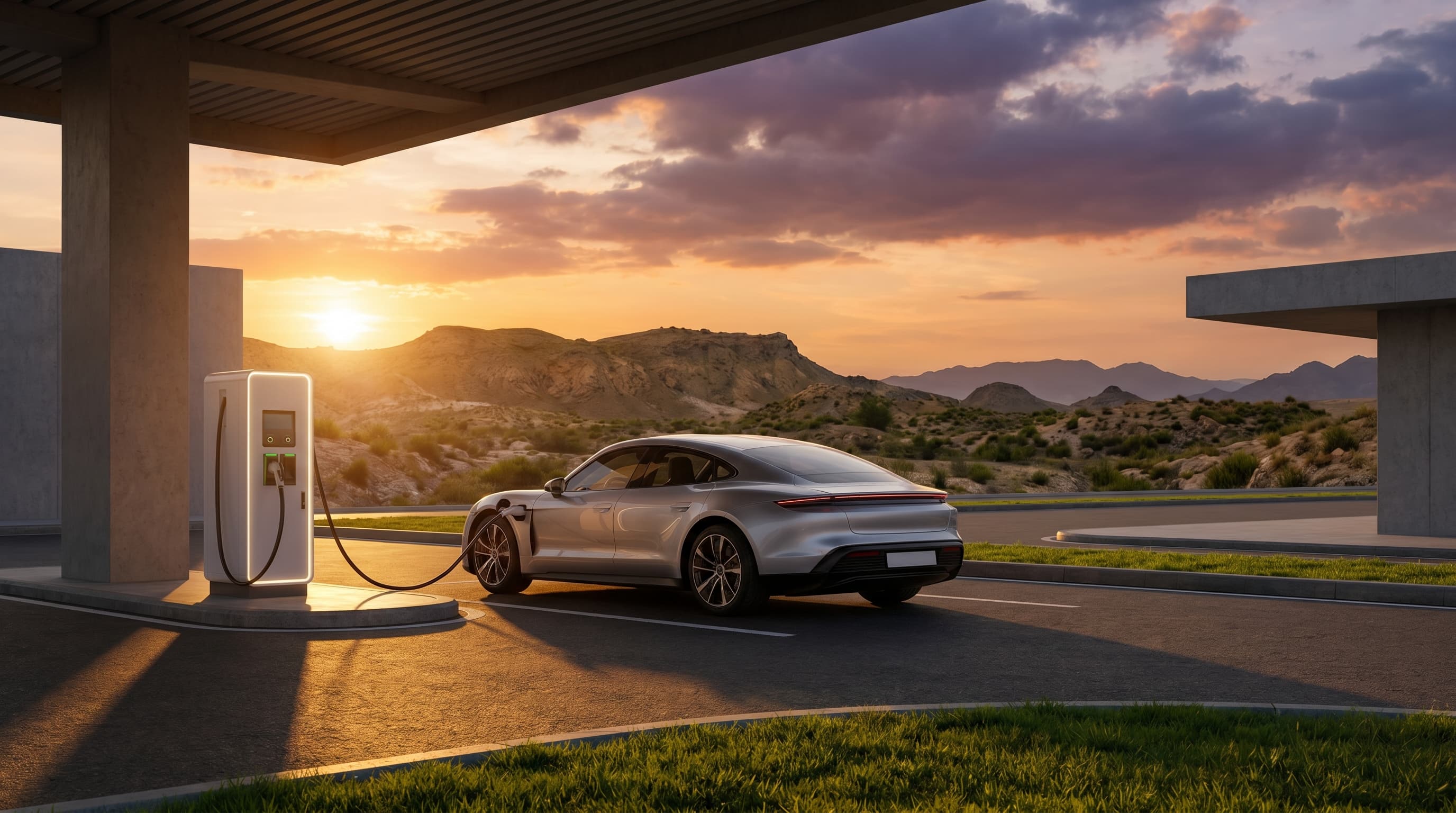
Walk up to a public EV charger in Pakistan for the first time and you will face an immediate question: does this plug actually fit your car? Unlike petrol stations where every nozzle fits every car, EV charging involves multiple incompatible standards — and choosing the wrong one wastes a trip. This guide explains every connector type present in Pakistan, which cars use which, and what you need to know before you travel.
There are four connector standards relevant to Pakistani EV drivers in 2026: CCS2, Type 2, CHAdeMO, and GB/T. Each serves a different purpose and a different set of vehicles. Understanding them takes about ten minutes — and it could save you hours on a long drive.
CCS2 — The Dominant DC Fast Charging Standard
CCS stands for Combined Charging System, and the "2" refers to the Type 2 AC base that sits at the top of the connector. CCS2 is the most important standard to understand in Pakistan because it is the connector used by virtually every DC fast charger at every major public network in the country.
The CCS2 connector looks distinctive: it has seven pins arranged across two sections. The upper section is identical to a Type 2 AC connector — five pins for AC charging. Directly below, two large DC pins are added, which handle the high-power direct current used for fast charging. This "combo" design means a single inlet on the car can accept both slow AC charging (using just the top section) and fast DC charging (using all seven pins).
In global terms, CCS2 supports up to 350 kW of power — fast enough to add 100 km of range in under five minutes in ideal conditions. In Pakistan today, the realistic range is 50 kW to 180 kW at public stations, with most running at 60 kW. That means a typical 60 kWh battery charges from 20% to 80% in roughly 40 to 60 minutes at a standard Pakistani public charger.
Every major charging network in Pakistan — Shell Recharge, PSO, and HUBCO Green Pakistan — uses CCS2 exclusively for DC fast charging. Bahria Town stations support CCS2 DC alongside Type 2 AC. If you own a mainstream EV sold new in Pakistan, CCS2 is your fast charging connector.
Cars that use CCS2 for DC fast charging in the Pakistani market:
- BYD Atto 3
- BYD Seal
- BYD Dolphin
- MG ZS EV
- MG4
- Proton e.MAS 7
- Audi e-Tron
- BMW iX
- Chery EV models
In short: if your EV was purchased new through an official dealership in Pakistan in the past three years, it almost certainly uses CCS2 for fast charging. You are well covered by the existing public network.
Type 2 (Mennekes) — The Universal AC Charging Standard
Type 2 is the AC charging standard used by virtually every modern electric car sold in Pakistan. It is named after the German manufacturer Mennekes, which designed the original connector, and it was adopted as the universal EV AC charging standard across Europe and much of Asia.
Type 2 is a seven-pin round connector — slightly smaller and rounder than CCS2 — and handles alternating current charging at speeds ranging from 3.7 kW (single phase, home socket) up to 22 kW (three phase, public AC station). The speed your car actually charges at depends on its onboard charger: the BYD Atto 3 and MG ZS EV, for example, have a 7 kW onboard charger, meaning they accept Type 2 at up to 7 kW regardless of how powerful the station is.
In Pakistan, Type 2 is the connector you will use for:
- Home wallboxes — all residential EV wallbox chargers sold in Pakistan use Type 2
- Public AC stations — most 22 kW city stations at shopping malls, hotels, and office buildings use Type 2
- Overnight charging at hotels on long journeys where DC fast chargers are unavailable
Because CCS2 incorporates the Type 2 connector in its upper section, your CCS2-compatible car has a single inlet that accepts both a Type 2 AC cable and a full CCS2 DC cable. You do not need a separate inlet or adapter — the same socket on the car handles both.
For most Pakistani EV owners, the day-to-day reality is simple: plug in your Type 2 cable at home every night, charge slowly overnight, and use CCS2 at a public fast charger when you need a quick top-up on the road. Type 2 does 90% of the work; CCS2 handles the rest.
CHAdeMO — A Japanese Standard Fading Fast
CHAdeMO is a DC fast charging standard developed by a Japanese consortium led by Nissan, Toyota, and Mitsubishi. It was one of the first DC fast charging standards to achieve significant global deployment and was — for a period in the early 2010s — the dominant DC standard in many markets.
The CHAdeMO connector is visually distinctive: a large, circular plug with a locking mechanism on the side. It is considerably bulkier than CCS2 and plugs into a dedicated DC inlet on compatible vehicles — separate from the AC inlet, unlike CCS2's combined design.
In Pakistan today, CHAdeMO is almost extinct as a practical charging option. Here is why:
- No mainstream EV sold new through official channels in Pakistan uses CHAdeMO — not a single model from BYD, MG, Proton, Audi, or BMW
- The only CHAdeMO vehicles in Pakistan are older Nissan Leaf units imported through the grey market, primarily from Japan
- Public CHAdeMO chargers are extremely rare — a small number of older private chargers exist, but none of the major networks (Shell Recharge, PSO, HUBCO Green) support it
- Nissan itself has stopped developing CHAdeMO for new models globally, and the standard is being phased out in Japan as well
If you own a grey-market Nissan Leaf — one of the most common imported EVs in Pakistan — you are carrying a CHAdeMO DC inlet and a Type 1 (J1772) AC inlet. Type 1 is a five-pin AC standard common in Japan and North America but not used by any public charging station in Pakistan. This creates a significant compatibility problem: you cannot use Pakistan's public fast charger network for DC charging, and you need a Type 1 to Type 2 adapter for public AC stations.
Practical advice for CHAdeMO owners: always verify that a station has CHAdeMO support before including it in a travel plan. Do not assume CCS2-to-CHAdeMO adapters will be available — they are extremely rare in Pakistan and cannot be relied upon. If you are considering a used imported EV, this compatibility issue is a serious reason to prefer a CCS2-equipped vehicle instead.
GB/T — The Chinese Standard You Probably Will Not Encounter
GB/T is China's national EV charging standard, developed and mandated by the Chinese government. It comes in two forms: a DC fast charging variant and an AC slow charging variant. The DC connector is visually similar to CHAdeMO in its separate-inlet approach, while the AC connector is a distinct nine-pin design.
GB/T is the dominant standard in China, and since China is the world's largest EV market, a vast number of vehicles globally are built with GB/T inlets. However, Pakistani BYD and MG owners do not need to think about GB/T. Here is why:
- BYD and MG (SAIC) adapt their vehicles for international markets. The Atto 3, Seal, Dolphin, ZS EV, and MG4 sold in Pakistan all use CCS2 for DC and Type 2 for AC — not GB/T
- These manufacturers specifically modify their export models for international charging standards. Buying new through an official Pakistani dealership guarantees a CCS2 and Type 2 vehicle
- Pakistan has no GB/T public charging infrastructure
The scenario where GB/T becomes relevant is grey-market Chinese vehicle imports. Vehicles imported directly from China — without going through an official Pakistani distributor — may retain their China-specification GB/T inlets. If you are considering a grey-market Chinese EV import, verify the charging standard before purchasing. A GB/T vehicle in Pakistan is effectively cut off from the entire public charging network.
The GB/T AC standard also appears on some Chinese-specification vehicles for slow charging. Again, this is not a concern for officially-sold Pakistani market vehicles, but it is worth checking on any grey-market import.
Pakistan Charging Network Compatibility at a Glance
Here is how Pakistan's major charging networks align with each connector standard:
- Shell Recharge: CCS2 DC only — 50 to 180 kW
- PSO stations: CCS2 DC — 60 kW
- HUBCO Green Pakistan: CCS2 DC — 60 kW
- Bahria Town stations: CCS2 DC plus Type 2 AC
- City shopping malls and hotels: Type 2 AC — 7 to 22 kW
- CHAdeMO support: extremely rare, limited to some older private chargers
- GB/T support: none available publicly in Pakistan
The pattern is clear: if your car uses CCS2 and Type 2 — which covers every officially-sold EV in Pakistan — you have access to the complete and growing public charging network. If your car uses CHAdeMO or GB/T, you are effectively off the network.
Which Car Uses Which Connector — Pakistan 2026
Below is every significant EV model in the Pakistani market and the charging connectors each uses:
- BYD Atto 3: CCS2 (DC fast, up to 80 kW) + Type 2 (AC, 7 kW onboard charger)
- BYD Seal: CCS2 (DC fast, up to 150 kW) + Type 2 (AC, 11 kW onboard charger)
- BYD Dolphin: CCS2 (DC fast, up to 60 kW) + Type 2 (AC, 7 kW onboard charger)
- MG ZS EV: CCS2 (DC fast, up to 76 kW) + Type 2 (AC, 7 kW onboard charger)
- MG4: CCS2 (DC fast, up to 135 kW) + Type 2 (AC, 11 kW onboard charger)
- Proton e.MAS 7: CCS2 (DC fast) + Type 2 (AC)
- Audi e-Tron: CCS2 (DC fast, up to 150 kW) + Type 2 (AC, 22 kW onboard charger)
- BMW iX: CCS2 (DC fast, up to 200 kW) + Type 2 (AC, 11 kW onboard charger)
- Nissan Leaf (grey market import): CHAdeMO (DC) + Type 1 J1772 (AC) — very limited Pakistan compatibility
Every officially sold EV in Pakistan uses the same two connectors. The only exception is the grey-market Nissan Leaf, which sits entirely outside the standard Pakistani charging ecosystem.
Practical Advice for Pakistani EV Drivers
Before you buy: If you are choosing between an officially sold new EV and a grey-market import, charging compatibility is a strong argument for the new vehicle. A CCS2 and Type 2 car gives you access to the complete and expanding public network. A CHAdeMO or GB/T vehicle effectively locks you out of public fast charging in Pakistan as of 2026.
For home charging: Install a Type 2 wallbox, not a basic three-pin socket adapter. A dedicated 7 kW wallbox charges a typical EV overnight and costs Rs 35,000 to 60,000 installed. It is the single most impactful upgrade you can make to your EV ownership experience in Pakistan.
For inter-city travel: Plan your CCS2 fast charging stops before you leave. Confirm which stations are operational and what their current power output is. The PSO, Shell Recharge, and HUBCO Green networks cover the major motorway corridors, but coverage outside those corridors remains limited in 2026.
Do not rely on adapters: CCS2-to-CHAdeMO adapters exist in some international markets but are extremely rare in Pakistan. Do not build a travel plan that depends on finding one. If you own a CHAdeMO vehicle, carry a verified list of CHAdeMO-capable chargers and confirm each is operational before departure.
Carry your Type 2 cable: CCS2 DC fast chargers at public stations in Pakistan are almost always tethered — the cable is permanently attached to the charger, and you simply plug it into your car. Type 2 AC chargers are typically untethered — you need to carry your own Type 2 cable. Your car should have come with one, and it should live in your boot permanently.
What to Expect as Pakistan's Network Grows
The picture for CCS2 will only improve. Every new public charging station announced in Pakistan — Shell Recharge's ongoing expansion, PSO's motorway rollout, HUBCO Green's network — defaults to CCS2. The standard has effectively won the Pakistani market because it is what every official EV brand has brought to Pakistan.
AC Type 2 infrastructure will also grow as property developers, hotels, and shopping centres add destination charging as a customer amenity. Several Lahore and Karachi malls have already installed Type 2 AC stations, and this trend will accelerate as the EV fleet grows.
CHAdeMO will not recover in Pakistan. It is a fading standard globally, and no new vehicle entering the Pakistani market will use it. If you own a CHAdeMO vehicle today, factor that reality into any decision about keeping or replacing it.
GB/T may become more visible if grey-market Chinese imports increase, but official Pakistani policy favours locally assembled or formally imported CCS2 vehicles. For practical purposes, GB/T remains irrelevant to the Pakistani public charging landscape for the foreseeable future.
The bottom line for any Pakistani considering an EV purchase in 2026 is straightforward: choose a CCS2 vehicle, install a Type 2 wallbox at home, and you will have access to the complete and growing public charging network. The connector question, for most buyers, has already been answered by the market.


