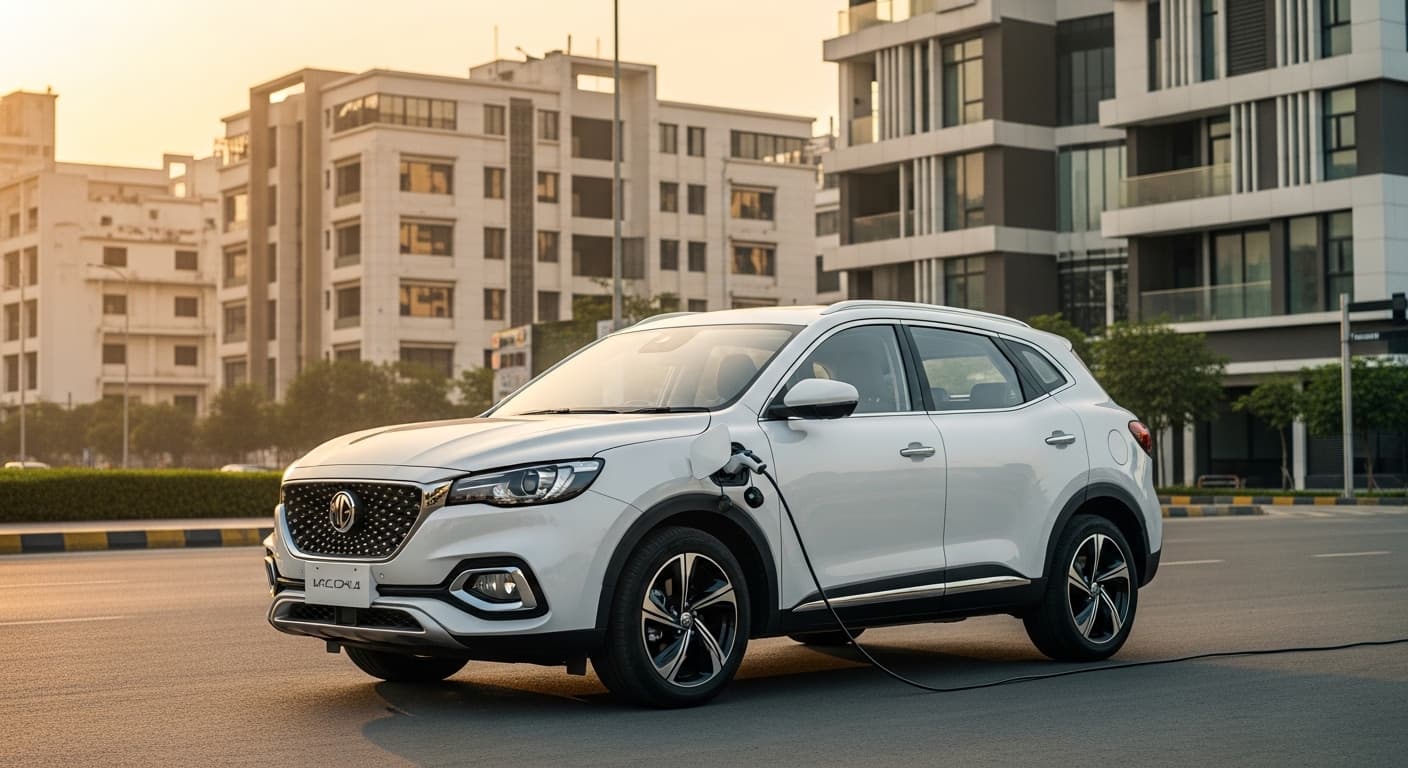
MG Motor Pakistan made a significant move in the country's new energy vehicle market on April 26, launching the second-generation MG HS in two electrified variants at an event held at its Lahore facility. The new HS Hybrid+ and HS Super Hybrid are not full battery-electric vehicles — but for the majority of Pakistani buyers who remain hesitant about range anxiety and charging infrastructure, they may be precisely the right product at the right moment.
Pakistan's public charging network is growing, but fast chargers remain sparse beyond the major motorway corridors. A plug-in hybrid like the Super Hybrid sidesteps that concern entirely for most daily use, while still delivering meaningful reductions in fuel costs. That practical positioning is what makes this launch worth paying attention to.
What MG Has Actually Launched
The second-generation MG HS arrives in Pakistan in two distinct powertrain configurations — and the difference between them matters, because they serve very different buyers.
MG HS Hybrid+ — PKR 9,499,000: This is a conventional self-charging hybrid (HEV). It pairs a 1.5-litre turbocharged petrol engine with an electric motor and a 1.83 kWh onboard battery, producing 165 kW and 340 Nm of combined output. This variant does not plug in — the battery charges itself through regenerative braking and engine power. It drives like a refined petrol SUV that happens to use significantly less fuel in urban stop-start traffic.
MG HS Super Hybrid — PKR 10,199,000: The Super Hybrid is a plug-in hybrid (PHEV). It carries a 24.7 kWh battery that charges externally, delivering an EV-only range of 50+ km on a full charge. Combined output reaches 209 kW and 480 Nm of torque. For buyers in Lahore or Karachi whose daily commute is under 40–45 km, this variant can cover most weekday driving entirely on electricity — with the petrol engine as a seamless fallback for longer trips.
Both are built on the global 2024-generation MG HS platform with a longer wheelbase than the outgoing model and a revised exterior design. Booking is open at PKR 1,500,000, with deliveries expected from June 2026.
What This Means for Pakistani EV Owners
The MG HS Super Hybrid is arguably the most practical new-energy vehicle for Pakistani conditions right now — more practical, in day-to-day terms, than a full battery-electric vehicle for many buyers.
A full BEV requires access to a working DC fast charger for longer trips, and Pakistan's charging network still has significant gaps outside the motorway corridor. If you drive primarily within Lahore or Karachi, a BEV is manageable. If you regularly travel to secondary cities, it requires careful advance planning using the route planner to identify charging stops.
The Super Hybrid eliminates that constraint entirely. Charge at home overnight on a standard domestic socket — no dedicated wallbox required. On electric power, you cover your daily commute. For weekend trips to Murree or family visits outside the city, the petrol engine takes over without any input from the driver. You never have to worry about locating a working fast charger.
For buyers who have been sitting on the sidelines of Pakistan's EV transition — interested in lower running costs but wary of charging infrastructure — the Super Hybrid is a logical, low-risk first step into electrified driving.
Key Details and Numbers
| Hybrid+ | Super Hybrid | |
|---|---|---|
| Type | HEV (self-charging) | PHEV (plug-in) |
| Battery | 1.83 kWh | 24.7 kWh |
| EV-only range | N/A | 50+ km |
| Combined power | 165 kW | 209 kW |
| Torque | 340 Nm | 480 Nm |
| Price | PKR 9,499,000 | PKR 10,199,000 |
| Booking amount | PKR 1,500,000 | PKR 1,500,000 |
| Delivery | June 2026 | June 2026 |
The PKR 700,000 gap between the two variants is modest given the meaningful difference in capability. For buyers who can stretch to the Super Hybrid's price, the PHEV is the better long-term choice: fuel savings from daily electric driving will recover that difference within 18–24 months of regular use.
Charging the Super Hybrid's 24.7 kWh battery from empty costs approximately Rs 1,000–1,500 at current residential electricity rates — versus Rs 2,800–3,200 for the equivalent 50 km on petrol. That is a per-kilometre saving of roughly 55–60% on electric driving, every day.
At PKR 9.5–10.2 million, both variants sit in premium territory. The BYD Atto 3 starts around PKR 8.5 million as a full BEV, while the BYD Sealion 7 exceeds PKR 13 million. The MG HS positions itself as a compelling mid-market option for buyers who want new-energy efficiency without the full commitment to battery-electric driving.
What Happens Next
Deliveries for both variants begin in June 2026 — roughly six weeks away for buyers booking now. MG Pakistan is also preparing to launch the MG 4 EV Urban, a lower-priced full-BEV variant of the MG 4, in May 2026. That launch will push MG's new-energy entry point downward and offer a fully battery-electric option for buyers committed to zero-emissions driving.
Together, the HS Hybrid+, HS Super Hybrid, and upcoming MG 4 Urban give MG a lineup covering three distinct buyer profiles: the budget-conscious full-BEV buyer, the range-anxiety-aware PHEV buyer, and the fuel-efficiency-focused conventional hybrid buyer. No other manufacturer in Pakistan currently covers that spread within a single model family.
For Pakistan's new energy vehicle market, the MG HS launch is a practical, well-timed expansion of what is genuinely usable for Pakistani drivers today — not a revolution, but a meaningful step forward.
Frequently Asked Questions
Can I charge the MG HS Super Hybrid at home without a wallbox?
Yes. The 24.7 kWh battery can be charged from a standard 220V domestic socket overnight. A dedicated EV wallbox speeds the process but is not required for typical home-charging use cases.
What is the difference between the Hybrid+ and the Super Hybrid?
The Hybrid+ is a self-charging hybrid — no plug, small 1.83 kWh battery, improved fuel efficiency but no significant electric-only driving. The Super Hybrid is a plug-in hybrid (PHEV) with a 24.7 kWh external-charge battery offering 50+ km of EV-only range — enough for most daily commutes in Pakistan's major cities.
How does the Super Hybrid compare to the BYD Atto 3?
The BYD Atto 3 is a full BEV offering around 480 km of total range but dependent on public fast chargers for longer trips. The Super Hybrid offers 50 km of daily electric range with a petrol engine for everything beyond that. The Atto 3 suits buyers fully committed to battery-electric; the Super Hybrid suits buyers who want electric savings without infrastructure dependency.
When do deliveries begin?
MG Pakistan has confirmed deliveries for both the Hybrid+ and Super Hybrid beginning June 2026. The booking amount is PKR 1,500,000.